A standard mahjong set contains 8 flower tiles — strictly, 4 Flowers and 4 Seasons.
They're usually counted together as the "bonus tiles," and they behave unlike anything else in the set.
What makes them different
Every other tile in mahjong comes in four identical copies. There are four 5-of-Bamboo, four East Winds, four Red Dragons.
The bonus tiles don't work that way. There is exactly one of each — one Plum, one Orchid, one Spring, one Summer, and so on. Eight unique tiles, no duplicates.
That single difference is why they can't form a Pung or a Kong the way ordinary tiles can. You can never hold three matching Flowers, because only one exists.
The two groups
The four Flowers: Plum, Orchid, Chrysanthemum, Bamboo — the "Four Noble Plants" of Chinese art.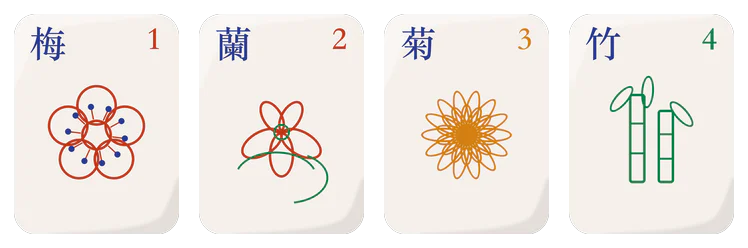
The four Seasons: Spring, Summer, Autumn, Winter.
Sets vary in how they're illustrated, and many are numbered 1–4 in the corner. That numbering matters in some variants, where a flower matching your seat position scores extra.
What they actually do
This is where variants diverge sharply.
As bonus tiles
In Chinese mahjong and most traditional play, drawing a Flower or Season means you set it aside face-up and immediately draw a replacement tile from the dead wall. It doesn't stay in your hand or count towards your melds — it just sits there earning you a scoring bonus at the end.
As jokers
In Indian Heritage Mahjong, the Flowers and Seasons are wildcards. They substitute for other tiles inside a Pung, Chow or Mixed Chow — with real restrictions:
Never in a Kong
Maximum one joker per meld
Not in an ordinary pair, unless your hand contains a Crotchet
That last rule creates the Knit Pair — a pair completed with a joker, legal only when a Crotchet meld is present.
Ignored entirely
Japanese Riichi mahjong typically drops the bonus tiles altogether and plays with 136 tiles.
Why they exist at all
Bonus tiles are the one part of a mahjong set that doesn't participate in the core puzzle, which raises a fair question: why include them?
Two reasons, both practical.
They add variance without adding complexity. In traditional scoring, drawing a Flower is a small windfall that costs nothing to understand. A beginner can enjoy the bonus without learning a new rule, which matters in a game that already asks a lot up front.
They speed the game up. Because a drawn Flower is replaced immediately from the dead wall, it effectively gives you a free extra draw. Over a hand, the eight bonus tiles pull roughly eight extra tiles into play, which shortens hands slightly and reduces washouts.
The numbering matters in some rulesets too. If your seat is East and you draw Flower 1, that match is often worth more than an unmatched bonus — a small reward for a coincidence you had no control over, which is very much in the spirit of the game.
So is it 8, or something else?
Eight is the standard. You'll encounter exceptions:
Riichi sets often exclude them → 136 tiles total
Some older sets include a second group of four → 12 bonus tiles
American mahjong ships eight jokers, which are a different thing entirely — printed as jokers, not flowers
If you're counting a set to check it's complete, expect 8 bonus tiles among 144.
Telling them apart
Bonus tiles are the ones beginners most often can't identify, because unlike suits they have no number to read and unlike honours there are only one of each.
Three things to look for:
A number in the corner, 1 to 4. Every bonus tile carries one. If you see a corner index but the tile isn't obviously a suit tile, it's a Flower or a Season.
A Chinese character naming it. The Flowers are 梅 (plum), 蘭 (orchid), 菊 (chrysanthemum) and 竹 (bamboo) — the Four Noble Plants. The Seasons are 春 (spring), 夏 (summer), 秋 (autumn) and 冬 (winter).
A picture rather than a symbol. Suit and honour tiles use abstract marks — dots, sticks, characters. Bonus tiles carry actual illustrations: a blossom, a lotus, a gourd. If it looks like a drawing of something real, it's a bonus tile.
That last cue is the fastest in practice. You don't need to read the character to know you've drawn something that isn't part of your hand — which is exactly what you want mid-game, when you're deciding quickly and the tile needs setting aside rather than studying.
Related
Play a free game and you'll see how jokers work in practice.
Common questions
How many flowers are in a mahjong set?
Eight bonus tiles: 4 Flowers and 4 Seasons, one of each.
Are Flowers and Seasons the same thing?
They're two groups of four, usually treated identically. Some variants score them separately.
Can you form a meld with flowers?
Not a Pung or Kong — only one of each exists. In variants that treat them as jokers they can substitute inside a meld.
Why did I draw a replacement tile?
In traditional play, a drawn Flower is set aside and replaced from the dead wall, so your hand stays the right size.