Mahjong is a four-player tile game of skill, memory and reading your opponents. It has been played in China since the 1800s, and while the rules look intimidating written down, most people play a competent first game within an hour.
This guide covers the version of the game every regional variant shares. Learn this and you can sit down at a Chinese, Japanese, American or Indian table and follow what's happening.
Not looking for the puzzle game? If you meant the solitaire where you clear a pyramid by matching pairs, that's a different game that borrowed the tiles. This guide is the real four-player one — and you can play it free here.
What you need
A 144-tile set
Four players
A table
That's it. No board, no dice strictly required, no scorekeeping to start.
The tiles
The set breaks into three groups.
Suits (108 tiles)
Three suits, numbered 1 to 9, four copies of each:
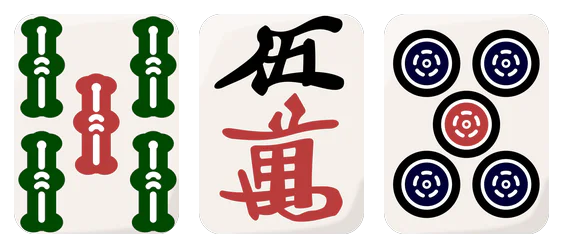
The number five in each of the three suits — Bamboo, Characters, Circles.
Honours (28 tiles)
Winds — East, South, West, North (four of each)
Dragons — Red 中, Green 發, White 白 (four of each)
Flowers and Seasons (8 tiles)
Four Flowers and four Seasons. Depending on the variant these are bonus tiles you set aside, or wildcards. Beginners can ignore them for a first game.
Total: 108 + 28 + 8 = 144.
The goal
Build a hand of four melds and one pair, then declare Mahjong.
A meld is a set of three or four tiles:
A Pung — three of the same tile:
A Chow — three in a row, same suit:
A pair is two identical tiles.
So a winning hand looks like: [meld] [meld] [meld] [meld] [pair] — fourteen tiles.
Setting up
Shuffle all 144 tiles face down.
Each player builds a wall of tiles in front of them; the four walls form a square.
Players take seats as East, South, West and North. East is the dealer and goes first.
Deal 13 tiles to each player.
You now hold 13 tiles that only you can see.
How a turn works
Play passes around the table. On your turn:
Draw a tile from the wall — you now have 14.
Discard one tile face up in the middle — back to 13.
That's the entire loop. Draw, discard, pass.
The skill is in which tile you throw away.
Claiming discards — where the game gets interesting
Here's the mechanic that turns this from solitaire into a real game.
When another player discards a tile you need, you can take it — even when it isn't your turn.
Call out what you're taking:
"Pung" — you have two matching tiles and the discard makes three. Any player can call Pung.
"Kong" — you have three matching and the discard makes four. Any player can call Kong.
"Chow" — the discard completes a run of three in the same suit. Only the player immediately next in turn order can call Chow.
"Mahjong" — the discard completes your entire hand. You win.
When you claim, the meld is placed face up in front of you. Everyone can see it — which is information you've just given away.
Play then resumes from you, skipping anyone in between.
When two people want the same tile
Priority runs:
Mahjong beats Kong and Pung, which both beat Chow.
If two players call Mahjong on the same tile, most house rules give it to whoever sits closer in turn order to the discarder.
Winning
Complete four melds and a pair and you declare Mahjong. You can do this two ways:
Self-drawn — you draw the winning tile from the wall yourself.
Claimed — you take a tile someone else discarded.
If the wall runs out before anyone wins, the hand is a draw and gets redealt.
Some variants also require you to announce that you're one tile away before you're allowed to win — declaring you're "ready", "fishing", or "tenpai" depending on tradition. Check which rules your table uses.
Your first game: five things to know
1. Concealed beats exposed. Every meld you claim goes face up, telling opponents what you're building. Claiming is fast but loud.
2. Honours are all-or-nothing. There are only four of each wind and dragon. If two are already discarded, that Pung is never happening — let it go.
3. Watch the discards. If nobody has thrown a Circle in ten turns, someone is collecting Circles. Don't feed them.
4. Middle tiles are flexible, terminals aren't. A 5 can complete runs of 3-4-5, 4-5-6 or 5-6-7. A 1 can only ever be in 1-2-3. Keep middles early.
5. Decide your hand early, then commit. Beginners hedge and end up with four half-finished melds. Pick a direction by the fifth or sixth turn.
Common beginner mistakes
Chowing everything. Just because you can claim doesn't mean you should. Each claim exposes your hand and costs you flexibility.
Forgetting the pair. Four melds and no pair is not a winning hand.
Discarding what you just watched someone claim. If a player Punged Green Dragons, they may well want more honours.
Playing too fast late. The last ten turns are where hands are lost. Slow down when opponents' exposures start looking complete.
Variants — what changes, what doesn't
Every regional version keeps the core: 144 tiles, four melds and a pair, draw-and-discard, claiming.
What differs is scoring, which special hands count, and how Flowers and Jokers behave.
Learn the core and switching between them is a matter of hours, not weeks.
Practise without three other people
The hardest part of learning mahjong has always been assembling a table.
You can play the full four-player game free in your browser against AI opponents — start on the easiest difficulty while the melds are still unfamiliar, and step up as they click.
There's also an interactive tutorial that walks you through your first hand tile by tile, and a set of daily puzzles once the basics are automatic.
Frequently asked questions
How long does a game take?
A single hand runs 10–20 minutes. A full traditional game of four rounds can take a couple of hours.
Is mahjong hard to learn?
The rules take about an hour. The strategy takes years — which is the appeal.
Can you play mahjong with 2 or 3 people?
Traditionally it needs four. Three-player variants exist with a suit removed. For two, online play lets you fill the empty seats with bots.
Is mahjong gambling?
It can be played for stakes, but it doesn't have to be. Online and club play is usually for points or rating.
What's the difference between mahjong and mahjong solitaire?
Completely different games that share a tile set. Solitaire is a single-player matching puzzle invented in the 1980s; mahjong is the four-player game described here.
Do I need to memorise scoring to start?
No. Play your first games to "first to complete a hand wins" and add scoring once the mechanics are automatic.