A standard mahjong set contains 144 tiles.
They break down into 108 suit tiles, 28 honour tiles (winds and dragons), and 8 bonus tiles (flowers and seasons).
The full breakdown
The 108 suit tiles
Three suits, each numbered 1 to 9, with four copies of every tile.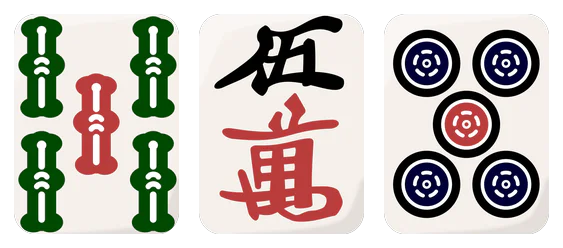
Bamboo (Bams, Sticks)
Characters (Wan, Cracks)
Circles (Dots, Balls)
That's 9 × 4 = 36 tiles per suit, and 36 × 3 = 108.
The 28 honour tiles
Four winds — East, South, West, North — at four copies each, giving 16.
Three dragons — Red, Green, White — at four copies each, giving 12.
The White Dragon is a blank tile in most sets. That isn't a defect; it's the traditional design.
The 8 bonus tiles
Four Flowers and four Seasons. Unlike every other tile, there is only one of each — no duplicates.
Depending on which variant you play, these are either set aside for a bonus when drawn, or used as wildcards. In Indian Heritage Mahjong they act as jokers — wildcards that can stand in for other tiles inside a meld.
Why some sets have more than 144
Open a set and count 148 or 152, and nothing is wrong. Common additions:
Blank tiles — spares, in case one is lost
Extra jokers — supplied for American mahjong, which uses eight
A fifth flower set — occasionally included in older sets
The core 144 is consistent across Chinese, Japanese, Taiwanese and Indian mahjong. What changes is how many of the bonus tiles a given ruleset actually uses.
How the 144 get used in a game
Counting the set is one thing; knowing where the tiles go is more useful.
After shuffling, players build the tiles into four walls that form a square in the middle of the table. Fourteen are set aside as the dead wall — a reserve that supplies replacement tiles when someone declares a Kong or draws a bonus tile. Those fourteen are never drawn in normal play.
Each player is then dealt 13 tiles, accounting for 52 more. That leaves roughly 78 tiles in the live wall to be drawn over the course of the hand.
Most hands end well before the wall runs out. When it does empty without a winner, the hand is a draw and gets redealt — a "washout." Experienced players track roughly how many draws remain, because a hand that can't complete in the tiles left is a hand you should be defending rather than building.
How many tiles are in each hand?
Thirteen between turns, fourteen during them.
You hold 13 tiles. On your turn you draw one — now 14 — decide which to throw, and discard back down to 13. That rhythm is the whole game.
A winning hand is 14 tiles: four melds of three tiles each, plus a pair. If you claim a Kong, that meld holds four tiles rather than three, so you draw a replacement from the dead wall to keep the arithmetic working.
How the count changes by variant
144 is the standard, but not every ruleset plays with all of it.
Japanese (Riichi) drops the Flowers and Seasons entirely and plays with 136 tiles. Riichi is built around a deep scoring system where bonus tiles would only add noise, so they're left out of the set.
American mahjong keeps the 144 and adds eight jokers on top, for 152. Those jokers are printed as jokers, not flowers, and behave as wildcards inside melds.
Three-player variants usually remove an entire suit — most often the Characters — bringing the set down to 108 tiles. Fewer players need fewer tiles, or the wall would never run out.
Indian Heritage Mahjong plays the full 144, with the Flowers and Seasons acting as wildcards rather than scoring bonuses.
If you're buying a set, 144 plus a few spare blanks is the safe default. It covers Chinese, Taiwanese and Indian play, and you simply set the bonus tiles aside for riichi.
One thing worth checking when a set arrives: count the honours. Missing suit tiles are obvious in play, because the numbers give them away. A single missing wind or dragon can go unnoticed for months, and it quietly distorts the game — every hand built on that tile becomes impossible without anyone understanding why.
Related
Want to see them in action? Play a free game in your browser.
Common questions
Is it always 144 tiles?
The core set is 144 across every major variant. Sets sometimes ship with spare blanks or extra jokers on top.
How many tiles does each player get?
Thirteen at the deal. You hold 13 between turns and 14 while deciding your discard.
Do you use all 144 in a game?
No. Fourteen are set aside as the dead wall, and most hands end before the wall is exhausted.