Mahjong is designed for four players. Three-player variants are well established and play properly; two-player mahjong is possible but changes the game significantly.
Why four
The four seats are named for the winds — East, South, West and North — and that isn't decoration. Seat position determines turn order, who may call a Chow, and in most variants your seat wind scores.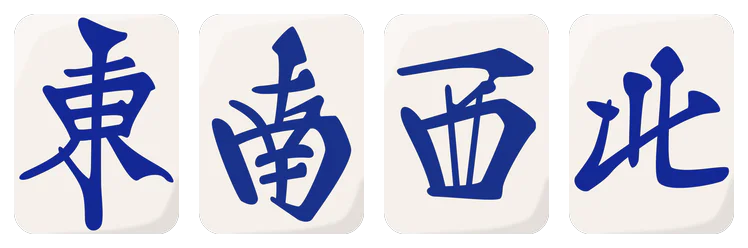
One seat per wind. East deals and plays first.
The tile arithmetic works out
Four also makes the tile arithmetic work. With 144 tiles, thirteen dealt to each of four players and fourteen set aside as the dead wall, the remaining wall lasts almost exactly long enough for a tense hand. Remove a player and there are far more tiles than the game needs.
It becomes a reading game
Most importantly, four players is what makes it a reading game. With three opponents discarding, you're tracking three developing hands at once and deciding which to defend against. That's where the depth lives.
Three players
Three-handed mahjong is genuine and widely played, particularly in Japan (sanma) and parts of China.
The usual adjustment is removing one entire suit — most often the Characters — bringing the set down to 108 tiles. Some versions instead drop the numbers 2–8 from a suit, keeping only terminals.
It plays fast and aggressively. With fewer players there are fewer discards to read, hands come together quicker, and there's less defensive information available. Many people prefer it. It is a legitimately different game, not a compromise.
Two players
Two-player mahjong exists, but be clear about what you lose.
The claiming mechanic — the thing that separates mahjong from solitaire — depends on multiple opponents feeding the discard pile. With one opponent, you see half the discards and there's no competition for a called tile. Chow only ever comes from one direction. Most of the strategic texture disappears.
If you only have two people, the better option is filling the empty seats with AI. You keep four-player structure, real claim competition and proper turn order, while both humans play at a real table. That's how most two-person households actually play online.
One player
Not traditionally possible — and worth stating plainly, because this is where a lot of confusion starts.
The single-player game most people have met is mahjong solitaire, the tile-matching puzzle. It shares the tiles and the name and nothing else. If that's what you're after, it's a different game — we've written about how the two compare.
To play real mahjong alone, use bots for the other three seats.
How the seats rotate
Four players doesn't just mean four people — it means four positions, and they move.
East is the dealer. When East wins a hand, they stay dealer and play another. When anyone else wins, the deal passes anticlockwise and everyone's seat wind shifts with it. A full traditional game runs until the dealership has gone all the way round, sometimes four times over — once for each prevailing wind.
That structure is why a "game" of mahjong is much longer than a hand. A single hand takes 10–20 minutes; a full four-round game can run several hours. Most casual and online play just scores individual hands instead, which is why an online game feels so much shorter than a table game.
It also explains why seat position isn't cosmetic. Being East carries an advantage — you draw first, and you keep dealing while you keep winning — so a fair game requires everyone to sit in every seat.
What to do with the players you have
What if you have five or more?
More than four is easier to solve than fewer.
Rotate players between hands
The traditional answer is rotation: four play, the rest sit out, and the loser of each hand — or whoever has been in longest — swaps with someone waiting. Mahjong hands are short enough that nobody waits long, and the enforced break is part of how the game has always been sociable rather than gruelling.
With five, some groups run a "floating" fifth who replaces the dealer each time the deal passes, so everyone gets an equal number of hands as East. With six or more, it's usually simpler to run two tables.
What doesn't work is trying to seat five at one table. Turn order, the Chow rule, and seat winds are all built on there being exactly four positions — adding a fifth breaks all three at once.
Related
Start a game with bots in any empty seat — free, no download.
Common questions
Can you play mahjong with 2 people?
Yes, but it loses most of the claiming strategy. Two humans plus two bots preserves the real game.
Can you play mahjong with 3 people?
Yes. Three-player variants usually remove a suit and are widely played, especially in Japan.
Can you play mahjong alone?
Not traditionally. Online you can fill all three other seats with AI opponents.
Does seat position matter?
Yes. It sets turn order, determines who may call a Chow, and usually affects scoring.